Chapter 1 — Fundamental Concepts
1.8 — Analytic Geometry
Analytic geometry translates figures into equations, and equations into figures: it is a dictionary between two languages that say the same thing.
Until now all the geometry in this book has lived in a single dimension: the real line, with the distance of §1.1 that we used in the inequalities of §1.7. This section takes the step to two dimensions. Each point of the plane will be described by a pair of real numbers, and with that, geometric figures can be described by equations. This is the idea of Descartes and Fermat in the seventeenth century: a circle, which for Euclid was a figure, also becomes the solution set of an equation, and geometric questions become algebraic questions.
§1. The Cartesian plane
Section titled “§1. The Cartesian plane”An ordered pair is a pair of numbers in which order matters: means that and . Thus and are different pairs. The set of all ordered pairs of real numbers is denoted :
To give a geometric picture, we draw in the plane two perpendicular lines, each with its scale of real numbers like the line of §1.1: the -axis, horizontal, and the -axis, vertical. They meet at the origin, which corresponds to the of both. Through each point of the plane we draw the perpendicular to the -axis and the perpendicular to the -axis. The numbers those perpendiculars mark on each axis are the coordinates of : the first, , is called the abscissa, and the second, , the ordinate, and we write . Conversely, each pair determines a unique point. This correspondence between points and pairs is the starting point of analytic geometry: from here on, we identify the plane with and speak interchangeably of the point or the pair.
The axes divide the rest of the plane into four regions, the quadrants, numbered counterclockwise starting from the one containing the points with both coordinates positive. Points lying on the axes belong to no quadrant.
§2. The distance between two points
Section titled “§2. The distance between two points”On the line, §1.1 defined the distance between and as . In the plane, distance is obtained by combining that idea with the Pythagorean theorem of Euclidean geometry.
Proposition. The distance between and is
Proof. Let us begin with a fact about real numbers: for every real , . Indeed, is nonnegative and its square is , because is or and ; by the uniqueness of the root in §1.2, is the square root of .
If , the two points lie on the same horizontal line and their distance is the distance between their abscissas, . The formula gives , and they agree. The case is analogous. In the general case, consider the auxiliary point . The segment is horizontal and measures ; the segment is vertical and measures . Since they are perpendicular, , and form a right triangle whose hypotenuse is , and by the Pythagorean theorem,
The right-hand side is nonnegative, because it is a sum of squares, and so is the distance; by the uniqueness of the root, is the square root of the right-hand side.
The proof uses a theorem of Euclidean geometry, the Pythagorean theorem, which does not follow from the axioms of . For that reason, from here on we adopt the formula as the definition of distance in . The proposition guarantees that this definition agrees with the distance of Euclidean geometry, and from now on all proofs about distances in the plane will be algebraic.
Example. The distance between and is .
§3. The midpoint
Section titled “§3. The midpoint”The midpoint of the segment joining and is the point of the segment at the same distance from both endpoints. Its coordinates are the averages of the coordinates of the endpoints.
Proposition. Let . Then
Proof. The differences of coordinates between and are and, likewise, . By the formula of §2,
where we used that for , by the quotient property of radicals in §1.2. The differences between and are and , the same ones, so gives the same value.
The proposition says that is equidistant from and , and that . In Euclidean geometry, the points whose distances to the endpoints add up exactly to the length of the segment are the points of the segment; therefore lies on the segment and is its midpoint.
Example. The midpoint of the segment joining and is , and its distance to each endpoint is , half of .
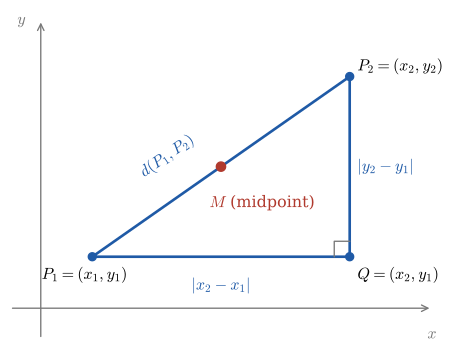
Figure 1.4 — The right triangle from the proof in §2, with the midpoint of §3 marked on the hypotenuse.
§4. The circle
Section titled “§4. The circle”A circle with center and radius is the set of points of the plane at distance exactly from the center. With the formula of §2, that geometric definition becomes an equation.
Proposition (standard equation of the circle). A point belongs to the circle with center and radius if and only if
Proof. By definition, belongs to the circle if and only if , that is, . By the proposition of §1.5 on equations with radicals, this equality holds if and only if and . Since , the second condition always holds, and the equation in the statement remains.
Here squaring adds no solutions, and §1.5 says why: the right-hand side, , is not negative.
Often the equation does not appear in its standard form but expanded, as . To recover the center and the radius we complete the square, as in §1.3, once in each variable. Since , and likewise with , the equation is equivalent to
Not every equation of this form is a circle. Let us call the number on the right-hand side. If , the equation is that of the circle with center and radius . If , a sum of two squares is zero only if both are zero, because each is nonnegative (§1.3), and the only point satisfying it is . If , no point satisfies it, because a sum of squares is not negative.
Example. Consider . Grouping and completing the square in each variable,
The right-hand side is positive: the equation is that of the circle with center and radius . On the other hand, leads to , which has no solution at all.
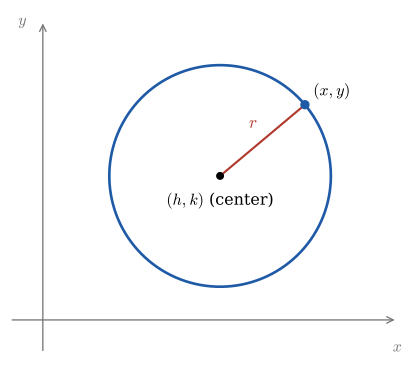
Figure 1.5 — Circle with center and radius : “distance to the center equals ” written in symbols.
§5. Symmetry
Section titled “§5. Symmetry”We call a curve the set of points of the plane that satisfy an equation in and ; the graph of the equation. A curve is symmetric with respect to the -axis if, for each point of the curve, also lies on it. It is symmetric with respect to the -axis if, for each , also lies on it, and symmetric with respect to the origin if does. Geometrically, is the reflection of in the -axis, its reflection in the -axis, and the opposite point through the origin.
These conditions are checked with algebra. The point satisfies the equation of the curve exactly when satisfies the equation that results from replacing by . Therefore, if that replacement yields an equation equivalent to the original, the curve is symmetric with respect to the -axis. Likewise, replacing by decides symmetry with respect to the -axis, and replacing both at once, symmetry with respect to the origin.
Examples. In , replacing by gives , the same equation: the curve is symmetric with respect to the -axis. In , replacing by and by gives , which is equivalent to : the curve is symmetric with respect to the origin. The circle has all three symmetries, because any of the replacements leaves the equation unchanged, since .
The three symmetries are not independent. If a curve is symmetric with respect to both axes, it is also symmetric with respect to the origin: from we pass to by symmetry with respect to the -axis, and from there to by symmetry with respect to the -axis.
With points, distances and curves now translated into algebraic language, it is worth pausing for a methodological reflection before going on: the next section examines what role graphing calculators and software play in this same work, and what care is required when relying on them.
Copyright © 2026 Carlos Dagorret — Licensed under Creative Commons Attribution-NonCommercial-NoDerivatives 4.0 International (CC BY-NC-ND 4.0)