Precalculus
Foundations of Mathematics
Section titled “Foundations of Mathematics”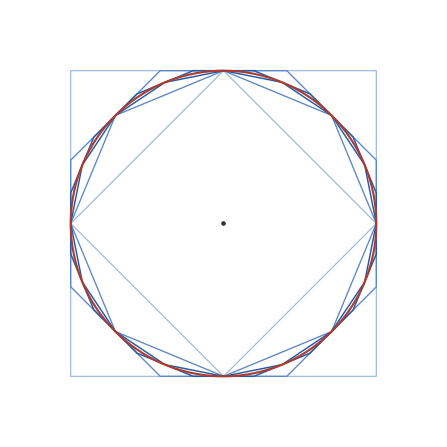
To prove is to know not only what is true, but also what that truth rests on.
This book gathers the algebraic, geometric and analytic tools that Calculus takes for granted, and presents them as what they are: a theory. It starts from the axioms of the real numbers and goes as far as the irrationality of . Along the way, every concept is defined before it is used, and every statement is either proved or explicitly flagged as pending. It is written for capable university students, in the tradition of the European treatises of the early twentieth century: in continuous prose, with complete proofs, and with the conviction that understanding why something is true is worth as much as knowing that it is.
It admits three readings. In the first, it is enough to go through the statements and the paragraphs around them to know what each section is about and where it is heading. In the second, one follows the proofs and the explanation of each symbol, and understands why the results are true. In the third, one returns to the details: the hypotheses each proof uses, the cases it excludes and the references that connect it to the rest of the work. Each chapter ends with an essay on the history and philosophy of its ideas, which can be read on its own.
The Journey
Section titled “The Journey”1. Fundamental Concepts. The real numbers and the supremum axiom, exponents, algebraic expressions, equations, inequalities, the Cartesian plane and the line.
2. Functions. The set-theoretic definition of function, domain, graphs, transformations, composition, inverses and optimization without Calculus.
3. Polynomials and Rational Functions. Real zeros, the construction of the complex numbers, the Fundamental Theorem of Algebra and rational functions.
4. Exponential and Logarithmic Functions. The extension of to real exponents, the construction of , logarithms and their applications.
5. Trigonometric Functions of Real Numbers. The construction of in the manner of Archimedes, the wrapping function and the six trigonometric functions.
6. Trigonometric Functions of Angles. The measurement of angles, the right triangle and the laws of sines and cosines.
7. Analytic Trigonometry. Identities, addition formulas, inverse functions, trigonometric equations, De Moivre’s theorem and vectors.
8. Systems of Equations and Inequalities. Gaussian elimination, matrices as transformations of the plane, determinants and linear programming.
9. The Conics as Loci. Parabola, ellipse and hyperbola from metric conditions, eccentricity, the invariance of the discriminant and the polar equation from the focus.
10. Induction, Recursion and Sums. The natural numbers as the smallest inductive set, definitions by recursion, the geometric series, the binomial theorem and the closing of the work.
Chapters 4 to 10 are being translated. Use the side menu or the navigation arrows at the foot of each page to move through the sections.
To my wife and children,
for the stolen time, the infinite patience
and the constant love that make every page possible.
Copyright © 2026 Carlos Dagorret — Licensed under Creative Commons Attribution-NonCommercial-NoDerivatives 4.0 International (CC BY-NC-ND 4.0)